

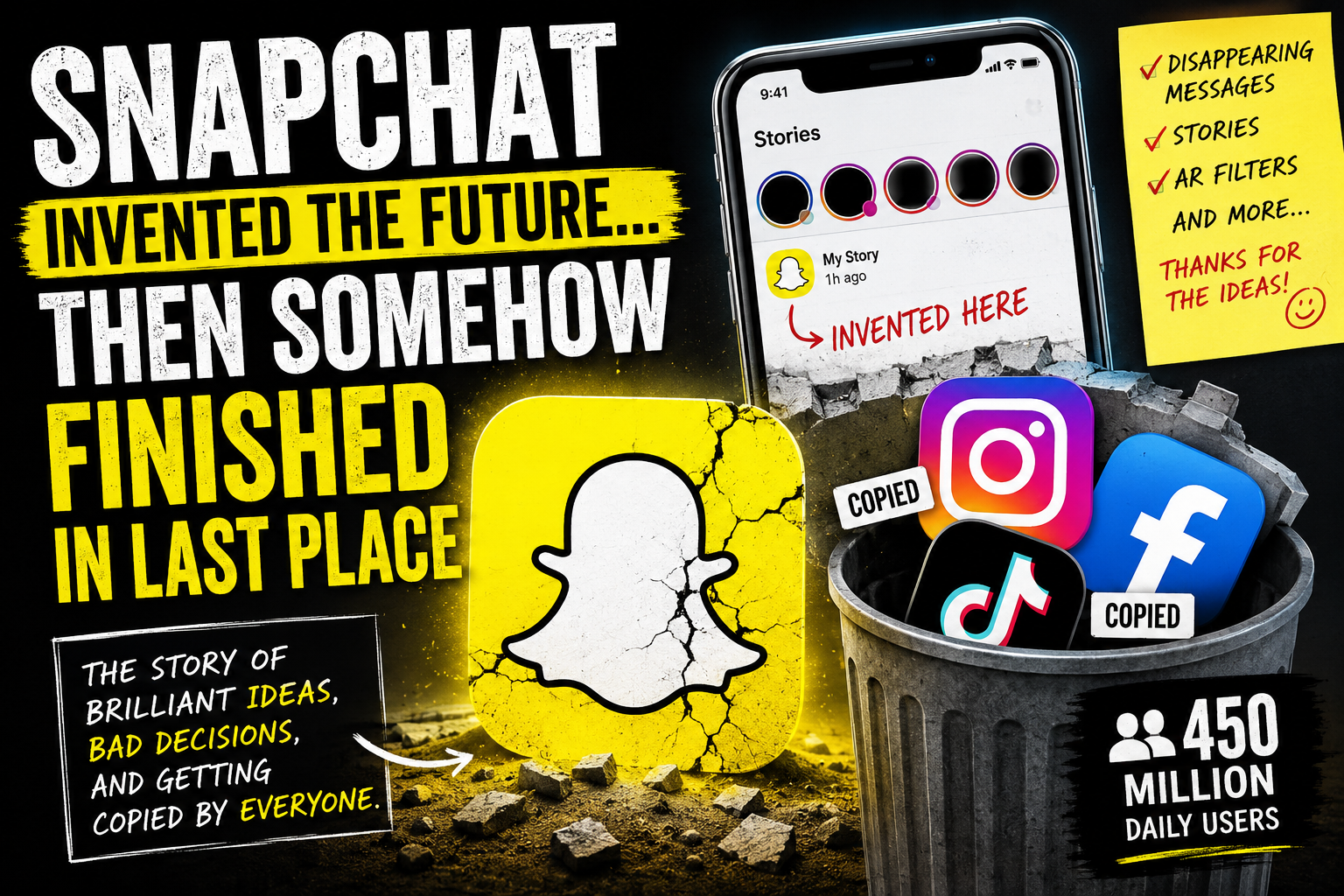
How Snapchat Invented the Future…Then Somehow Finished in Last Place

Every once in a while a company comes along that changes an entire industry.
Apple gave us the smartphone.
Netflix changed how we watch TV.
Amazon turned two-day shipping into "Why isn't it here yet?"
Then there's Snapchat.
Snapchat invented disappearing messages. Stories. AR filters. The selfie culture that somehow convinced millions of people duck lips were a personality trait. They were years ahead of everyone else.
So naturally...everyone else made all the money.
It's almost impressive.
Imagine inventing the hamburger only to watch McDonald's, Burger King, Wendy's, Five Guys, and the gas station down the road become billion-dollar businesses while you're still arguing over the recipe.
That's basically Snapchat.
Today, more than 450 million people still use Snapchat every day, yet the company somehow feels like the kid who aced every homework assignment but failed the final exam.
They pioneered features that Instagram, Facebook, TikTok, Apple, and Google happily borrowed, polished, and turned into money-printing machines.
The weird part?
Most people think Snapchat lost because its ideas weren't good enough.
The exact opposite is true.
Snapchat's ideas were almost too good.
The real reason they keep losing has nothing to do with technology. It has everything to do with leadership, strategy, and one CEO who believed being right was more important than listening.
And as it turns out, that's a pretty expensive personality trait.
The App That Was Built on a Great Idea...and an Ugly Beginning
Like a lot of billion-dollar tech companies, Snapchat's story starts in a college dorm room.
Back in 2011, three Stanford students kicked around an idea that was actually pretty brilliant.
What if you could send a picture that disappeared instead of living on the internet forever?
Today that doesn't sound revolutionary. Back then? It was.
Facebook was becoming everyone's permanent scrapbook. Every embarrassing party photo, every questionable haircut, every "I'm deep because I quoted a song lyric" status update...it all lived online forever.
People were starting to realize that maybe documenting every terrible decision they'd ever made wasn't the greatest long-term strategy.
One of those students, Reggie Brown, pitched the disappearing-photo idea. Evan Spiegel reportedly loved it, calling it a million-dollar concept. The app was originally called Peekaboo, and development moved quickly.
Then things got...Silicon Valley.
Just a month after launch, Brown was pushed out of the company. No ownership. No credit. Nothing.
Eventually he sued.Snap admitted in its IPO filing that it settled with Brown for $157 million.
That's an expensive way of saying, "Yeah...maybe we should've handled that a little differently."
Ironically, Snapchat spent the next decade watching larger companies do almost the exact same thing to them.
Instagram copied Stories.Facebook copied disappearing messages.
TikTok changed short-form content.
Apple built disappearing messages directly into iMessage.
Google jumped into augmented reality.
It's almost poetic.Snapchat spent years complaining that everyone kept stealing its ideas.
The problem is...that's exactly how its own story started.
There's an old saying about karma. Whether you believe in it or not, Snapchat certainly gave it one heck of a stress test.
When Bad Publicity Turns Into Great Marketing
Here's where the story takes an unexpected turn.Spiegel originally believed Snapchat would become the perfect place for people to send private photos that wouldn't exist forever.
Let's just say the media had a field day with that.Before long, Snapchat had earned a reputation as the app for sexting.
Normally, that kind of press would kill a startup.Instead, teenagers downloaded it in droves.By 2013, users were sending roughly 400 million photos every single day—about the same number of photos being uploaded to Facebook at the time.
Unfortunately, advertisers aren't exactly lining up to sponsor what parents think is a digital version of the back seat of a 1998 Honda Civic.
Snapchat had users.It had explosive growth.
What it didn't have was a business model advertisers loved.
And that would become a recurring theme.
Over the next decade, Snapchat repeatedly proved something that's surprisingly common in business:
Being popular isn't the same thing as building a great business.
Just ask every restaurant that's packed on Friday night but somehow closes six months later.
The $3 Billion Decision That Changed EverythingBy 2013, Snapchat wasn't just another startup. It had become the social media app every tech company was watching.
One of those companies happened to be Facebook.
And one of the people watching most closely was Mark Zuckerberg.
Now, if there's one thing you should know about Zuckerberg, it's this: when he sees something he likes, he has two strategies.
Option A: Buy it.
Option B: Build your own version and pretend it was your idea all along.
He's done it repeatedly over the years. Instagram. WhatsApp. Oculus. If buying doesn't work, Plan B usually kicks in faster than your neighbor borrowing your lawn mower and suddenly forgetting where he got it.
So Zuckerberg offered Snapchat $3 billion.
Today that number doesn't sound outrageous in Silicon Valley, where companies somehow lose money for ten straight years and still get billion-dollar valuations. But remember, Snapchat had just six employees.
Six.
That's roughly $500 million per employee.
I've worked with some incredibly talented people over the years, but if someone offered half a billion dollars because I happened to be sitting in the office, I'd probably help carry the server out to their car.
Instead, Evan Spiegel said no.
At the time, people applauded him.
He wasn't selling out.
He believed Snapchat could become something much bigger.
Honestly, I probably would've believed it too.
The problem wasn't saying no.
The problem was assuming the conversation was over.
It wasn't.
Zuckerberg Doesn't Usually Lose
According to the story, Zuckerberg basically responded with the corporate equivalent of:
"That's okay. I'll just build my own."
Facebook's first attempt was an app called Poke.
It flopped
Then they tried again.
That flopped too.
Most companies would've admitted defeat and moved on.
Mark Zuckerberg isn't most companies.
In 2016, Facebook stopped trying to build a separate Snapchat competitor and instead copied Snapchat's biggest feature directly into Instagram.
Stories.
Not "inspired by."
Not "similar to."
It was essentially Snapchat with Instagram's logo slapped on top.
Even Instagram's own leadership publicly acknowledged that Snapchat deserved the credit for inventing the feature.
The difference?Instagram already had hundreds of millions of users.
They didn't need to convince people to download a new app.
They simply gave existing users one more reason never to leave.
It's a little like inventing the world's greatest cheeseburger...only to have McDonald's put your exact recipe on every menu in America next Tuesday.
Congratulations.
You won the innovation award.
They won the customers.
Great Ideas Aren't Enough
This is where I think a lot of people misunderstand business.
Being first is exciting.
Being best is even better.
But neither one guarantees you'll win.
History is littered with companies that invented incredible technology only to watch someone else figure out how to monetize it.Palm made smartphones before the iPhone.
MySpace dominated social media before Facebook.Blockbuster laughed at Netflix.
Yahoo laughed at Google.
Kodak invented the digital camera...then practically gift-wrapped the future for everyone else.
Snapchat belongs on that list.Not because it lacked innovation.
Because innovation without execution is like owning the fastest race car in the world and forgetting to hire a driver.Ideas are valuable.
Execution is priceless.
The Mistake That Instagram Never MadeHere's where Snapchat quietly made one of the biggest mistakes in social media history.
They thought people came for the disappearing photos.
They didn't.
People came because their friends were there.
Those are two completely different businesses.
Instagram understood something Snapchat never seemed to grasp: creators don't just create content—they build communities.
Every time someone follows you on Instagram, YouTube, or Facebook, you're building an asset. Your audience grows over time. Your old posts continue getting views. A video you made three years ago can still make money while you're sleeping.
It's the closest thing the internet has to compound interest.Snapchat?
Every post disappeared.
Every day you started over.Imagine opening a coffee shop where every customer forgot you existed the second they walked out the front door.
That's basically the Snapchat business model.
The Platform That Forgot About Creators
This became painfully obvious as YouTubers, influencers, businesses, and brands started treating content creation like an actual career.
Creators weren't looking for an app that deleted everything.They wanted somewhere they could build something.
Followers.
Subscribers.
Email lists.
Communities.
A business.
Snapchat gave them temporary attention.
Instagram gave them permanent audiences.
Guess which one paid the bills?
Even today, ask a creator where they'd rather have 100,000 followers.
Almost nobody is choosing Snapchat.
Not because Snapchat is a bad app.
Because audiences are assets.
Temporary views are just...temporary.
Then Snapchat Did the One Thing You Never Do
If you've ever owned a business, you know there's one universal rule.
Don't make life harder for your best customers.
In 2018, Snapchat apparently skipped that meeting.
The company rolled out a massive redesign.
On paper, it probably looked fantastic.
PowerPoint presentations usually do.
In reality?
Users hated it.
Creators hated it.
Influencers hated it.
Almost everyone hated it.
Reports later suggested employees had warned leadership the redesign wasn't ready.
Those warnings didn't exactly make it to the suggestion box marked "Things We'll Listen To."
Within months, Snapchat lost millions of users.
More than a million people signed a petition asking the company to bring the old version back.
Think about that for a second.People rarely sign petitions.
Most of us won't even leave a five-star review for a restaurant we love.
But over a million people took time out of their day just to say, "Please put it back the way it was."
That's the digital equivalent of your customers showing up outside your office carrying pitchforks.
Then Kylie Jenner Pressed Send
As if things weren't bad enough, one post on social media made everything worse.
Kylie Jenner tweeted:"Sooo does anyone else not open Snapchat anymore? Or is it just me?"
That's it.
One sentence.
No 20-minute YouTube exposé.
No detailed review.
Just one casual observation.
Wall Street noticed.
Snapchat reportedly lost roughly $1.3 billion in market value shortly afterward.
Now, to be fair, Kylie didn't single-handedly erase a billion dollars.
She simply said out loud what millions of users were already thinking.
Sometimes the biggest problem isn't bad publicity.
It's confirming what everyone already suspects.
Technology Was Never the Problem
Here's the crazy part.
Snapchat kept inventing incredible features.
Stories.
AR filters.
Disappearing messages.
Augmented reality lenses.
They were consistently ahead of almost everyone else.
The problem wasn't innovation.
The problem was that every time Snapchat built something amazing, Meta, Apple, Google, or TikTok looked over the fence and thought...
"Thanks. We'll take it from here."
And because those companies already had larger ecosystems, bigger audiences, and stronger creator economies, they usually won.
It's a brutal lesson.
Being first gets your name in the history books.
Being adaptable keeps you in business.
The Final Lesson: Snapchat Didn't Lose Because It Was Dumb
If you've made it this far, you might think this is a story about a company that made terrible products.
It isn't.
Snapchat made some of the best products in social media.
That's what makes this story so fascinating.
They invented disappearing messages before anyone else thought they mattered.
They popularized Stories.
They turned augmented reality filters into something your grandma now accidentally uses on Facebook.
They were early to camera-based communication.
And they were talking about AR glasses years before most people knew what augmented reality even meant.
So how does a company that keeps inventing the future keep finishing behind everyone else?
Because products don't build billion-dollar companies.Ecosystems do.
The Difference Between Building a Feature and Building a Moat
Here's a mistake businesses make every day.
They become obsessed with features.
"Our software has this."
"Our product does that."
"We have the newest technology."
That's great.
Until someone with ten times your customer base copies it.
Features can be cloned.
Communities can't.
Relationships can't.
Trust can't.
Apple didn't become Apple because it made one great phone.
Google didn't dominate search because its homepage looked prettier.
Meta didn't become a giant because of Stories.
Those companies built ecosystems that made it difficult for people to leave.
Snapchat kept building features.
Everyone else kept building kingdoms.Guess who won?
Leadership Matters More Than Most People Want to Admit
One thing kept popping up throughout Snapchat's history.
Employees warned leadership about bad decisions.
Leadership pushed forward anyway.
The app redesign.
Creator relationships.
Monetization.
Multiple reports suggested there were plenty of smart people inside the company raising concerns.
The problem wasn't a lack of intelligence.
The problem was whether anyone at the top was willing to listen.
That's true whether you're running a Fortune 500 company or the local pizza shop.
The smartest person in the room usually isn't the one doing all the talking.It's the one asking the best questions.
There's an old business saying:
"If everyone around you agrees with everything you say, one of you is unnecessary."
I'd argue that's even more true when billions of dollars are on the line.
So...Is Snapchat Actually a Failure?
Not even close.
Let's keep some perspective.
Hundreds of millions of people still use Snapchat every day.
Evan Spiegel is worth billions.
Most entrepreneurs would happily trade places with him before you finished reading this sentence.
Calling Snapchat a failure would be ridiculous.B
ut calling it a missed opportunity?
That's a much stronger argument.
This wasn't supposed to be the company everyone copied.
It was supposed to be the company everyone chased.
Instead, it became Silicon Valley's research and development department.
Snapchat came up with the ideas.
Everyone else figured out how to make more money from them.
That's a painful distinction.
The Takeaway
If there's one lesson every entrepreneur, marketer, business owner, and creator can steal from Snapchat, it's this:
Innovation gets attention.
Execution builds companies.
Listening keeps them alive.
The best leaders aren't the ones who think they're always right.
They're the ones who understand they won't be.
Sometimes the biggest competitive advantage isn't having the smartest idea in the room.
It's being humble enough to know someone else might have a better one.
Snapchat changed the internet.
There's no debating that.
The irony is that while everyone else was copying Snapchat's features...
Very few copied its mistakes.
And that's probably the biggest lesson of all.